Starting a fitness plan is a transformative step for your health. It not only lowers the risk of chronic diseases but also boosts balance and coordination. With numerous exercise options out there, finding the right workout routine for your goals can be daunting.
A well-crafted fitness program aligns with your objectives, whether it’s weight loss, muscle gain, or overall health improvement. This article will help you craft a personalized fitness plan. It will provide tips and exercises to aid in your success.
Key Takeaways
- Understand the importance of a tailored fitness plan.
- Learn how to set realistic fitness goals.
- Discover effective exercises for different fitness objectives.
- Explore tips for maintaining motivation and tracking progress.
- Find out how to adjust your fitness plan as your goals evolve.
Understanding the Importance of a Structured Workout Routine
A structured workout routine is the cornerstone of successful fitness outcomes. It offers a clear plan, guiding individuals to stay focused and reach their fitness goals.
Having a well-organized exercise regimen is essential for steady progress. It ensures all muscle groups are worked and allows for proper recovery.
The Science Behind Consistent Exercise
Regular exercise leads to physiological changes that boost fitness. It stimulates muscle growth, improves heart health, and increases metabolism. The science behind it is based on progressive overload, gradually increasing workout intensity to keep making progress.
Benefits of Following a Planned Routine
Following a strength training routine or any planned exercise regimen brings many benefits. It prevents plateaus, lowers injury risk by promoting balanced muscle growth, and boosts mental well-being through a sense of accomplishment and structure.
By embracing a structured workout routine, individuals can maximize their fitness and reach their goals more effectively.
Identifying Your Fitness Goals
Your fitness goals act as a roadmap for your daily workout plan and gym schedule. Clear objectives keep you focused and motivated on your fitness journey. Whether aiming to lose weight, build muscle, or boost endurance, knowing your goals is key.
Common Fitness Objectives
Many have fitness goals like weight loss, muscle gain, better cardiovascular health, or improved athletic performance. Weight loss aims to reduce body fat, while muscle gain seeks to increase muscle mass. Tailoring your workout routine to these goals is essential.
Setting SMART Fitness Goals
To set effective fitness goals, they must be Specific, Measurable, Achievable, Relevant, and Time-bound (SMART). For instance, “I want to lose weight” is not specific. A SMART goal is “I will lose 10 pounds in 3 months with a consistent gym schedule and daily workout plan.”
Tracking Progress Effectively
Monitoring your progress is critical to reaching your fitness goals. Use a workout log, mobile apps, or wearable devices to track your journey. Here’s a simple table to show how to track progress:
| Week | Workout Frequency | Weight Lifted |
|---|---|---|
| 1 | 3 times | 10 kg |
| 2 | 3 times | 12 kg |
| 3 | 4 times | 15 kg |
Regularly tracking your progress lets you adjust your gym schedule and workout plan. This ensures you stay on track to meet your fitness goals.
Assessing Your Current Fitness Level
Evaluating your fitness level is a critical step towards achieving your health and fitness goals. Understanding your current fitness status helps identify your strengths and weaknesses. This knowledge allows you to craft a more effective workout plan. It also helps in setting realistic goals and tracking your progress over time.
To measure your aerobic and muscular fitness, flexibility, and body composition, simple at-home fitness tests are effective. For instance, walking 1 mile can assess your cardiovascular endurance. Doing pushups evaluates your upper body strength. Measuring your waist circumference monitors your body fat percentage. These tests serve as a baseline for developing a cardio workout plan tailored to your needs.
Simple At-Home Fitness Tests
Simple at-home fitness tests are a convenient way to assess your fitness level without needing any special equipment or a gym membership. Start by assessing your cardiovascular endurance with a 1-mile walk or run. For muscular strength, try doing as many pushups as you can until exhaustion. Measuring your waist circumference can give you insights into your body composition.
Other tests include assessing your flexibility by seeing how far you can reach forward while seated on the floor, or evaluating your muscular endurance by performing a series of squats or lunges. These tests are not only easy to perform but also provide valuable data to help you tailor your at-home workout schedule.
When to Seek Professional Assessment
While at-home fitness tests are useful, there are times when seeking a professional assessment is advisable. If you’re new to exercise or have health concerns, consulting with a fitness professional or a healthcare provider is recommended. They can provide a more accurate and personalized assessment. They can also identify any health risks and recommend a safe and effective workout plan for you.
A professional can also offer guidance on proper exercise techniques. This is essential to avoid injuries and get the most out of your workout. This is critical if you’re planning to start a new exercise regimen, including high-intensity activities or if you have any pre-existing medical conditions.
Essential Components of an Effective Workout Routine
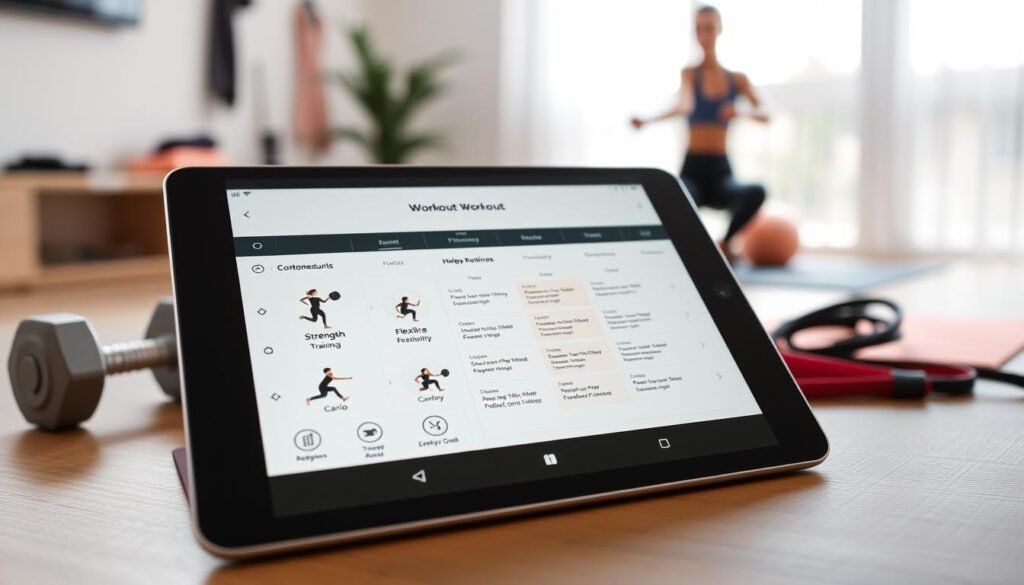
A well-structured workout routine is multifaceted, including elements that enhance cardiovascular health, strength, and flexibility. To create a personalized workout program, it’s essential to understand how these components work together to achieve overall fitness.
Cardiovascular Training Elements
Cardiovascular training is a critical component of any workout routine, aimed at improving heart health and increasing endurance. Activities such as running, cycling, and swimming are excellent examples of cardio exercises that can be tailored to different fitness levels. Incorporating high-intensity interval training (HIIT) can also enhance cardiovascular benefits.
Strength Training Fundamentals
Strength training is vital for building muscle mass, boosting metabolism, and physical strength. A well-rounded strength training program should target all major muscle groups, including legs, arms, chest, back, and core. Using a mix of free weights, resistance bands, and bodyweight exercises can help keep the routine engaging and prevent plateaus.
Flexibility and Mobility Work
Flexibility and mobility exercises are critical for maintaining range of motion, preventing injuries, and physical performance. Incorporating stretching routines, yoga, or Pilates can improve flexibility, while mobility exercises can help maintain joint health.
| Component | Description | Examples |
|---|---|---|
| Cardiovascular Training | Improves heart health and endurance | Running, Cycling, Swimming |
| Strength Training | Builds muscle mass and boosts metabolism | Free Weights, Resistance Bands, Bodyweight Exercises |
| Flexibility and Mobility | Maintains range of motion and prevents injuries | Stretching, Yoga, Pilates |
By incorporating these essential components into your workout routine, you can create a personalized workout program that meets your specific fitness goals and enhances your overall well-being.
How to Design Your Perfect Workout Routine
Creating an effective workout routine demands careful consideration of several key factors. A well-designed fitness plan should align with your specific goals. Whether you aim to shed pounds, build muscle, or boost endurance, the plan must reflect these objectives.
Determining Optimal Workout Frequency
The frequency of workouts hinges on your fitness goals and current fitness level. For most adults, starting with 3 to 4 workouts per week is advisable. Yet, this can fluctuate based on the workout’s intensity and type.
Selecting Exercises for Your Goals
Choosing the right exercises is vital for achieving your fitness goals. For weight loss, a blend of cardio and strength training is often suggested. For muscle building, focus on resistance exercises with progressive overload.
Structuring Your Workout Week
Effectively structuring your workout week involves balancing different exercises and recovery time. A well-rounded routine might include cardio, strength training, and flexibility exercises, spread throughout the week.
Adjusting Intensity and Volume
Adjusting workout intensity and volume is critical for progress and avoiding plateaus. As you grow stronger or more endurance-capable, increase the intensity or volume of your workouts to challenge yourself further.
| Workout Type | Frequency | Intensity |
|---|---|---|
| Cardio | 3 times/week | Moderate to High |
| Strength Training | 2-3 times/week | High |
| Flexibility | 2-3 times/week | Low to Moderate |
By meticulously planning your workout routine, you can craft a fitness plan that efficiently helps you reach your goals. This includes determining the optimal frequency, selecting the right exercises, structuring your week, and adjusting intensity and volume.
Best Workout Routines for Weight Loss
Starting a weight loss journey requires understanding the most effective exercise routines. A well-designed workout plan is key to shedding pounds. It significantly enhances the weight loss process.
Several approaches can lead to weight loss through exercise. The goal is to find a routine that burns calories, builds muscle, and improves fitness.
High-Intensity Interval Training (HIIT) Plans
HIIT involves short, intense exercise bursts followed by brief rest periods. It’s highly effective for weight loss, boosting metabolism and calorie burn. A typical HIIT session includes sprints, burpees, or jump squats, lasting 15-20 minutes.
Cardio and Strength Combinations
Combining cardio with strength training offers a well-rounded workout. It burns calories and builds muscle. For example, start with 20 minutes of cardio, then do strength training exercises targeting major muscle groups. This routine aids in weight loss and improves fitness.
Metabolic Resistance Training
Metabolic Resistance Training (MRT) uses resistance exercises to increase metabolic rate. It involves minimal rest between sets, leading to significant calorie burn. Circuit training with dumbbells or resistance bands are examples of MRT.
Sample 4-Week Weight Loss Routine
Here’s a 4-week weight loss routine combining HIIT, cardio, and strength training:
| Week | Workout Type | Frequency |
|---|---|---|
| 1 | HIIT | 3 times |
| 2 | Cardio + Strength | 4 times |
| 3 | MRT | 3 times |
| 4 | Combined Routine | 4 times |
Fitness expert
“The key to successful weight loss is consistency and patience. A well-structured workout routine can make all the difference.”

Incorporating these effective workout routines into your lifestyle can lead to significant weight loss and improved health.
Muscle Building Workout Routines
To achieve significant muscle growth, understanding and applying the right daily workout plan is essential. A well-structured gym schedule can make a substantial difference in your muscle-building journey.
Progressive Overload Principles
Progressive overload is a fundamental principle in muscle building. It involves gradually increasing the weight or resistance you’re lifting over time to challenge your muscles and stimulate growth. Incorporating progressive overload into your gym schedule ensures that your muscles are consistently challenged.
Split Routines vs. Full Body Workouts
When designing a daily workout plan, one must decide between split routines and full-body workouts. Split routines involve dividing your workout into specific muscle groups, while full-body workouts engage multiple groups at once. Both methods have their advantages, and the choice depends on your fitness goals and experience level.
Optimal Rep Ranges and Rest Periods
Understanding the optimal rep ranges and rest periods is key for effective muscle building. Typically, a range of 8-12 reps is considered optimal for hypertrophy. Rest periods between sets should be around 60-90 seconds to allow for adequate recovery.
Sample 8-Week Hypertrophy Program
Here’s a sample 8-week hypertrophy program that incorporates progressive overload and optimal rep ranges:
| Week | Workout Type | Sets x Reps | Rest Period |
|---|---|---|---|
| 1-2 | Full Body | 3 x 8-12 | 60-90 sec |
| 3-4 | Split Routine | 4 x 8-12 | 60-90 sec |
| 5-6 | Full Body | 3 x 8-12 | 60-90 sec |
| 7-8 | Split Routine | 4 x 8-12 | 60-90 sec |
By following this structured program and adjusting it according to your progress, you can effectively achieve your muscle-building goals.
Endurance and Cardiovascular Fitness Routines
A well-structured cardio workout plan is vital for boosting cardiovascular health and endurance. It enhances the heart, lungs, and blood vessels’ ability to deliver oxygen to muscles during prolonged physical activity.
Building Aerobic Capacity
Improving aerobic capacity is key to better cardiovascular fitness. Activities that elevate your heart rate and boost blood flow, like running, cycling, or swimming, are essential. Consistency is critical; aim for at least 150 minutes of moderate-intensity aerobic exercise weekly.
Cross-Training Approaches
Cross-training involves mixing up your workout routine with different exercises. This method prevents boredom and challenges your body in various ways, promoting balanced fitness. For instance, combining running with cycling or swimming boosts cardiovascular fitness while lowering injury risks.
Sample 6-Week Endurance Building Program
A structured at-home workout schedule can be as effective as a gym-based program. Here’s a sample 6-week plan that gradually increases in intensity:
- Weeks 1-2: 30 minutes of brisk walking or jogging, 3 times a week.
- Weeks 3-4: Introduce cycling or swimming for 30 minutes, 2 times a week, alongside walking/jogging.
- Weeks 5-6: Increase the duration to 45 minutes and frequency to 4 times a week, mixing cardio activities.
By adhering to a structured program and incorporating cross-training, you can greatly enhance your endurance and cardiovascular fitness. Always listen to your body and adjust the intensity according to your fitness level.
At-Home Workout Schedules with Minimal Equipment
At-home workouts can be highly effective, even with minimal equipment. This allows individuals to reach their fitness goals from home. A structured at-home workout schedule keeps you on track and helps you progress towards your fitness goals.
Effective Bodyweight Exercise Routines
Bodyweight exercises are essential for at-home workouts. They need no equipment and can be tailored to fit various fitness levels. Push-ups, squats, lunges, and planks are great for building strength and endurance. Adding these to your routine can provide a full-body workout without equipment.
Begin with 3 sets of 10 push-ups, 3 sets of 15 squats, and 3 sets of 20-second planks. As you get stronger, increase the sets or reps to keep challenging yourself.
Making the Most of Limited Equipment
Basic equipment like resistance bands or dumbbells can enhance your at-home workout. Resistance bands are lightweight and inexpensive, adding resistance to your movements. Dumbbells target different muscle groups with various strength training exercises.
“The key to a successful workout is not the equipment you use, but the consistency and intensity you bring to your routine.” – A fitness expert.
Sample No-Equipment Workout Plan
Here’s a 4-day workout plan that requires no equipment:
- Day 1: Upper body – 3 sets of 10 push-ups, 3 sets of 10 tricep dips (using a chair), 3 sets of 10 arm circles.
- Day 2: Lower body – 3 sets of 15 squats, 3 sets of 10 lunges per leg, 3 sets of 15 calf raises.
- Day 3: Core – 3 sets of 20-second planks, 3 sets of 15 Russian twists, 3 sets of 10 leg raises.
- Day 4: Total body – 3 sets of 10 burpees, 3 sets of 10 mountain climbers, 3 sets of 10 jump squats.
Injury Prevention and Safety in Your Workout Routine
To achieve your fitness goals, injury prevention in your exercise regimen is key. A well-structured workout routine not only helps you reach your objectives but also ensures safety.
Proper Warm-Up and Cool-Down Protocols
A proper warm-up prepares your muscles for exercise, increasing blood flow and reducing strain risk. This includes 5-10 minutes of light cardio and dynamic stretching. A cool-down helps your body return to its resting state, reducing muscle soreness.
Form and Technique Essentials
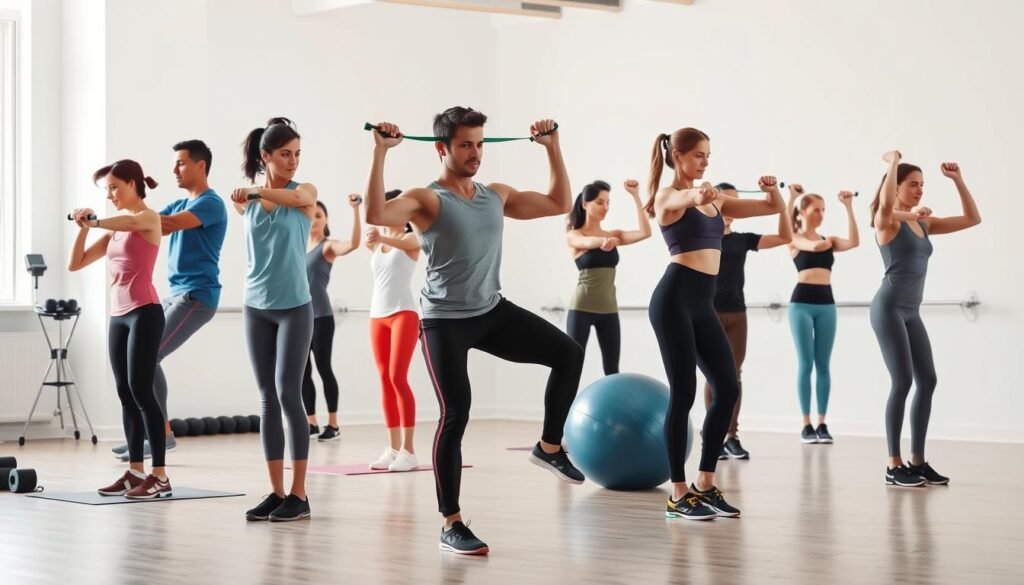
Maintaining correct form and technique during exercises is vital to prevent injuries. It’s recommended to
Recognizing Warning Signs of Overtraining
Overtraining can lead to serious injuries and burnout. It’s essential to recognize the warning signs, such as persistent fatigue, decreased performance, and increased resting heart rate. Listening to your body and adjusting your workout routine can help prevent overtraining.
Conclusion
Consistency and patience are key to reaching your fitness goals through a well-thought-out workout plan. A well-designed fitness plan, along with proper nutrition and recovery, is vital for success. Understanding the importance of a structured workout routine and setting clear fitness goals is essential. This allows you to craft a strength training routine that meets your specific needs.
It’s important to evaluate your current fitness level and monitor your progress. With a solid plan, you can reach your desired outcomes. Stay committed, and you’ll be on your way to a healthier, fitter you.
Sources
The data in this article comes from trusted sources, ensuring its accuracy and reliability. This makes the content dependable for readers.
Some of the sources referenced include:
- Mayo Clinic: Exercise and Fitness
- American Heart Association: Fitness
- American College of Sports Medicine: Guidelines for Exercise Testing and Prescription
These sources offer evidence-based insights into exercise and physical fitness. They help in creating effective workout routines.
FAQ
What is the best workout routine for weight loss?
For weight loss, combining High-Intensity Interval Training (HIIT) with strength training is key. A 4-week routine might include cardio and strength exercises. Metabolic resistance training also plays a significant role.
How often should I work out to achieve my fitness goals?
Workout frequency varies based on your goals and fitness level. For muscle building, 3-4 times a week is typical. Endurance goals might require 4-5 times a week.
What are the essential components of an effective workout routine?
An effective routine includes cardio, strength training, and flexibility exercises. These elements ensure a well-rounded fitness program, leading to overall fitness.
How do I assess my current fitness level?
Assess your fitness with simple tests at home, like heart rate checks or timed runs. Professional assessments from certified trainers can also be beneficial.
What is the importance of proper warm-up and cool-down protocols?
Warm-ups and cool-downs prevent injuries and ensure safety. They prepare muscles for exercise and aid in recovery.
How can I create a personalized workout routine at home with minimal equipment?
Use bodyweight exercises like push-ups, squats, and lunges for a home workout. Adding minimal equipment, such as resistance bands or dumbbells, can enhance your routine.
What is progressive overload, and how does it help with muscle building?
Progressive overload involves gradually increasing the weight or resistance to challenge muscles. This stimulates growth, building strength and muscle.
How can I track my progress and stay motivated?
Use measurements, weight, or workout logs to track progress. Setting SMART fitness goals keeps you focused and motivated.